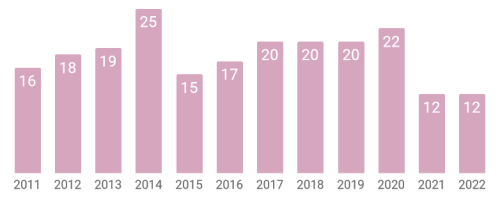
I read 12 books last year. Two on my Kobo e-reader and the rest were deadtree format. Eight of them were fiction. Four were non-fiction. Nightly reading with the girls continues. My commute to work is back (after a nearly three year work-from-home pause) so I expect 2023 to see an increase in books.
Two of the books read this year were written by close friends, which was a treat.
Fiction in 2022
- Perhaps the Stars - Ada Palmer - The conclusion to the epic Terra Ignota quartet. “Did we poison our ethics with the trolley problem?”
- To Sleep in a Sea of Stars - Christopher Paolini - “Eat the path, or the path will eat you.”
- The Immortalist - Chloe Benjamin - “Here’s what happens: you make choices, and then they make choices. Your choices make choices.”
- Rumours of Virtue - Sam Popowich - Authenticity and trauma Winnipeg.
- Vita Nostra - Marina & Sergey Dyachenko - Sasha is a verb in the imperative mood.
- Tinkers - Paul Harding - “[B]e comforted in the fact that the ache in your heart and the confusion in your soul means that you are still alive, still human, and still open to the beauty of the world, even though you have done nothing to deserve it.”
- Termination Shock - Neal Stephenson - Climate change solutionism and the Line of Actual Control.
- Late Nights on Air - Elizabeth Hay - The long and sudden of it all.
Non-Fiction in 2022
Top Books Written by Friends in 2022
Happy to have read two books written by friends in 2022, one fiction, one non.
Rumours of Virtue - Sam Popowich
“[E]very image distorts the reality people suppose it just
records. It abstracts, it selects, it changes the emphasis, the perspective. I say the image does that, but of course it’s the photographer who does it, in the first instance. But they are not alone, not the sole author of this fakery: everyone who developed the scientific theory of optics, everyone who manufactures cameras, everyone who designs sensors. In the old days, I would have said everyone who produced and developed film and prints. A myriad decisions go into the production of an image that, out of a profoundly naive understanding of technology, people tend to believe is a direct and unmediated capture of what actually exists.
Disgraced photo-journalist Nick Maitland is forced to confront the traumas he harbours, and the impacts of his decisions, when accused of faking his most celebrated image.
The story of a self-obsessed hedonist and what happens when we reject our obligations to society in the name of ego, pleasure, celebrity, or even artistic expression.
"Sure, people are responsible for their own lives, but they aren’t solely responsible. They inherit things from their parents, from their teachers, from the world around them. You don’t start a world over again, fresh, you have to make do with what’s given to you, which includes a world full of other people.”
Chase That Smile - Harold Cabrera
“Life is good. Thank you, thank you, thank you!”
Harold Cabrera is a man with a plan! Actually he had three plans. Before the age of 40 Harold dreamt of running the Paris Marathon, climbing Mount Kilimanjaro, and completing an Ironman triathlon. Not to spoil anything, but he accomplished all three, and went on to write this book about the planning, training, and determination it took to do so.
It’s a special thing to have a friend like Harold. His positivity is infectious and his ability to seek out and revel in good times is second to none. Also inspiring are the physical challenges he puts himself through, and it’s not just big races. By way of Strava I get to see Harold running, cycling and swimming each and every day of the year. Harold reminds us to challenge ourselves, to recognize when life is good, and to be grateful for it all.
Top Three Books of 2022
Late Nights on Air - Elizabeth Hay
“Despite the red glow of the on-air light, he then pushed through the studio door, only to be met by one of the great mysteries of life. We look so very different from the way we sound. It’s a shock, similar to hearing your own voice for the first time, when you’re forced to wonder how the rest of you comes across if you sound nothing like the way you think you sound. You feel dislodged from the old shoe of yourself.”
Friendship and love in 1970s Yellowknife through the eyes of a group of CBC radio journalists. A pipeline proposal and its impact on the indigenous people of Northwest Territories. An epic but ill-fated canoe trip. Winner of the 2007 Giller Prize.
Vita Nostra - Marina & Sergey Dyachenko
“She was caught and pulled up like a kite, while her body left on the grass remained inert. A thread that connected her to this anchor helped her soar and kept her close. She felt the trees as her arms, and grass, as her hair. A lightning struck, torn leaves flew by, and Sasha laughed with pure joy.
She knew herself to be a word spoken by the sunlight. She laughed at the fear of death. She understood what she was born for and what she was destined to carry out. All this happened while the lightning remained in the sky, a white flash.”
Suggested to me by Sam when I mentioned I liked grammar-based magic systems. Sasha is coerced by a strange man to enter the Institute of Special Technologies. This book is weird and dark and philosophically pretenious in the best of ways. There’s not much more I can say. It’s full of “concepts that cannot be imagined but can be named” and vice versa. Originally written in Ukranian by spouses Maryna and Serhiy Dyachenko. Serhiy Dyachenko passed away last year.
Building Thinking Classrooms - Peter Liljedahl
“For a curricular task to generate thinking, it should be asked before students have been shown how to solve it. Does this mean the task should come right at the beginning of the lesson? Yes.”
Back in June I attended a PD session at work by Peter Liljedahl. Afterwards I tweeted:
Very rarely do I leave a staff PD session thinking “oh wow, time to rethinking everything!” but here we are.
Fourteen (at times unituitive) teaching practices for building a classroom where students engage in solving problems as a community of learning. Read over a few nights this summer, I’ve already put some of these practices into place at the college. I’ll definitely re-read this book soon while taking careful notes.
Family Books in 2022
We read 100 story books and graphic novels from the library, including Lumberjanes vol 14 through 17, plus a few chapter books for good measure.
The Best (Kids’ Pick): The Undercover Book Club - Colleen Nelson
The bookworm and the class clown. Takes place in Winnipeg.
The best (Dad’s Pick): Flora and Ulysses: The Illuminated Adventures - Kate DiCamillo
Of cynics and superheros. An existential adventure for children. A book that treats kids like adults while making adults feel like kids.
“‘Do not hope; instead, observe’ were words that Flora, as a cynic, had found useful in the extreme. She repeated them to herself a lot.”
Honestly, I wish I could just quote the entire book here.
“All words at all times, true or false, whispered or shouted, are clues to the workings of the human heart.”
The girls enjoyed the movie too; I thought it was a travesty.
Podcasts in 2022
Apparently I listened to 636 podcast episodes, across 32 podcasts, for a total of 500+ hours (20+ days!).
New podcasts:
Podcasts where I listen to nearly every episode:
ADSP, CBC Spark, Eric Normand, Game Dev Advice, Invisibilia, Lex Fridman, Long Now Seminars, Nice Game Club, Overdue, Philosophy Bites, Sean Carroll’s Mindscape, Song Exploder, Stuff Dutch People Like, The Bike Shed, This American Life
Occasional listens:
CBC Ideas, Conversations with Tyler, CppCast, Hanselminute, Philosophize This!, The Tim Ferris Show, Syntax
Favourite Podcasts of 2022
Some of my favourite episodes from the past year, listed alphabetically by show:
CBC Spark: Human and AI Consciousness, What AI can and can’t do
CBC Ideas: Reith Lectures: Artificial Intelligence and Human Existence, The Authoritarian Personality, Maria Ressa: Last Two Minutes of Democracy
Conversations with Tyler: Chuck Klosterman on Writing the Part and Relishing the Present, Lydia Davis on Language and Literature
Lex Fridman: Lee Cronin: Origin of Life, Aliens, Complexity, and Consciousness, Ariel Ekblaw: Space Colonization and Self-Assembling Space Megastructures, John Vervaeke Meaning Crisis, Atheism, Religion & the Search for Wisdom, Michael Levin: Biology, Life, Aliens, Evolution, Embryogenesis & Xenobots, John Carmack: Doom, Quake, VR, AGI, Programming, Video Games, and Rockets, Todd Howard: Skyrim, Elder Scrolls 6, Fallout, and Starfield
Long Now Seminar: Sean Carroll: The Passage of Time and the Meaning of Life, Dorie Clark: The Long Game: How to be a long-term thinker in a short term world, Steward Brand, Jonathan Haidt, Kevin Kelly: Democracy in the Next Cycle of History
Overdue: Romona Quimby Age 8
Philosophy Bites: Josiah Ober on the Civic Bargain
Reply All: The Contact List
Sean Carrol: Anil Seth on Emergence, Information and Consciousness, Kate Jeffery on Entropy, Complexity, and Evolution, C. Thi Nguyen on Games, Art, Values, and Agency
Stuff Dutch People Like: The One Where we EAT All the Dutch Snacks, The One about the Dutch and Money, The One About Biking, Three Kisses, and how Dutch men can’t flirt
Tim Ferris - Margaret Atwood - A Living Legend on Creative Process, Susan Cain - Transforming Pain, Building Your Emotional Resilience, Professor Donald Hoffman - The Case Against Reality