"Writing, like talking, is the art of expressing thoughts in words.... But there is, necessarily, a vast difference between the oral and the scriptural use of words. When we talk, we have for our ministers not words only, but also gesture, play of feature, modulation of the voice's tone, and regulation of its pace, whereby we may subtly temper or accentuate the words themselves, and fit them, be they never so carelessly chosen, exactly to our meaning. When we write, we have nothing but words, words, with those little summary and meagre things whose hard office is to ape the variable pauses of the human voice.... Thus is style in the modern sense a far more complex thing than style in the eighteenth century's sense. To express through printed words all the little side-lights of thought and fine shades of meaning that are in him is the task of the modern stylist; and the tricks and formalities which must be gone through in accomplishing that task carry him further and further away from his ordinary manner in colloquy. It is that very manner which he is trying to reproduce; but the only medium for its reproduction lies leagues away from it. Modern prose style is further removed from colloquialism than was the prose style of the eighteenth century, for this paradoxical reason: that colloquialism is its model."
Max Beerbohm, letter, quoted in David Cecil's biography, p.146
via Geoffrey Nunberg's
Leaves from a Language Commonplace Book.
Found near-by:
Found
adjacent to:
appealing:
Comment
--------
From George Orwell's 1946 essay on Politics and the English Language:
"The word Fascism has now no meaning except in so far as it signifies 'something not desirable.' The words democracy, socialism, freedom, patriotic, realistic, justice have each of them several different meanings which cannot be reconciled with one another. In the case of a word like democracy, not only is there no agreed definition, but the attempt to make one is resisted from all sides. It is almost universally felt that when we call a country democratic we are praising it: consequently the defenders of every kind of regime claim that it is a democracy, and fear that they might have to stop using that word if it were tied down to any one meaning. Words of this kind are often used in a consciously dishonest way. That is, the person who uses them has his own private definition, but allows his hearer to think he means something quite different."
A half of a century has passed. The rhetoric of Western foreign policy continues to focus on the proliferation of freedom and democracy.
Comment
--------
Meta [May 2004]
Steven Johnson, pop-science author, majored in Semiotics as a Brown undergrad. His latest blog entry deals with this "theoretical education" and lead me to Paul Greenberg's article on the Brown Semiotics major.
Greenberg states that "semiotics is about how we derive meaning from context." He goes on to explain the Ferdinand de Saussure, who coined the term, "posited that no word is inherently meaningful. Rather a word is only a 'signifier', i.e. the representation of something, and it must be combined in the brain with the 'signified', or the thing itself, in order to form a meaning-imbued 'sign'."
Having often pondered the role of context, analogy and symbolism in Memetics, Semiotics could prove to be a fascinating tool.
Some online Semiotics resources:
Interestingly enough, Magritte's Pipe is a common signifier for the field of Semiotics, because of course, it isn't a pipe.
Also of interest, is the Wikipedia entry on the Philosophy of Perception.
Comment
--------
Whereas the last post dealt with books, this post will highlight what is keeping my mind busy online.
Natalie Chicha's new blog, Another, provides "an online space for [her] thoughts on depression and literature." Two interesting posts:
The editorial board of
Cognitive Science has made available
10 classics from their archives.
Unheard-of Curiosities is a collection of writings by Umberto Eco. A Rose by Any Other Name, deals with the problems of literary translation.
Thirty-eight dishonest tricks which are commonly used in argument, with the methods of overcoming them. A look at straight and crooked thinking by Robert H. Thouless.
A musical ebook series: Form, Counterpoint, Harmony and Artistic Orchestration.
Some chapters from the 2002 revision of The Social Life of Information are available online.
Paul Graham's essays touch on everything from hackers and painters to personal taste.
Finally, the coolest way to fold a t-shirt, ever. [Quicktime]
Comment
--------
I'm addicted to information. Books have always been my favourite knowledge narcotic. My search for used books to fuel Glutton University was successful this month:
- Language Truth and Logic - Alfred Jules Ayer - Read the condensed edition here. (Related: More Squashed Philosophers)
- Intro To Logic - I. Copi & C. Cohen - A first year philosophy Logic textbook. (Related: How to tell a logical story [pdf])
- The Basic Writing of C. G. Jung - It's about time I read some Jung.
- The Origin of Consciousness in the Breakdown of the Bicameral Mind - Julian Jaynes - The introduction of which can be read here.
- An Anthropologist on Mars - Oliver Sacks - Seven paradoxical tales of neurological disease - Excerpt here: The hug machine.
- On Writing Well - William Zinsser - Excerpt here: Clutter.
- The Algorithmic Beauty of Plants - P. Prusinkiewicz & A. Lindenmayer - Can mathematical L-Systems define the structure of plants? (Related: L-System java applet)
- Images of Medicine - Edited by Jim Harter - 4800 historical medical engravings. (Related: The medical images of the Clendening library)
No more than 4 dollars was spent on each book. Avoid Amazon, support your local (used) book stores and your public library.
Comment
--------
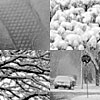
Back in November, I posted some snapshots of a Winnipeg winter. It is now mid-May, and again, winter visits our little prairie town.
Comment
--------
Generation5 contains a wealth of AI information.
I've long been fascinated by Genetic Programming.
From the above link: [Genetic Algorithms] are basically algorithms based on natural biological evolution. [...] A GA functions by generating a large set of possible solutions to a given problem. It then evaluates each of those solutions, and decides on a "fitness level" (you may recall the phrase: "survival of the fittest") for each solution set. These solutions then breed new solutions. The parent solutions that were more "fit" are more likely to reproduce, while those that were less "fit" are more unlikely to do so. In essence, solutions are evolved over time. This way you evolve your search space scope to a point where you can find the solution. Genetic algorithms can be incredibly efficient if programmed correctly.
When I discovered this article on a Genetic Algorithm that "evolves" a text string, I knew I would have to port the code to Processing. The results:
GA Words - Click to reset Text String Gene Pool. [permalink]
GA Images - Click to reset Image Gene Pool. [permalink]
GA Images (Large Image) - Click to reset Image Gene Pool. [permalink]
The first applet uses a Genetic Algorithm to evolve a text string from a gene pool of 4096 randomly seeded text cells.
The second applet uses the same GA to evolve a 625 pixel image from a gene pool of 1024 randomly seeded image cells.
Because the GA doesn't guarantee a perfect solution, the resultant text string or image must only be considered the best guess (so far). This is why the first applet doesn't always evolve the correct string. Left to run over night, the second applet will still only produce an approximation of the desired image.
The third applet uses the same framework, but the desired image contains 2500 pixels. Because of the increased pixel size (and a gene pool of 2048 images) this applet must be run on a powerful computer (1GHz+ processor with at least 256MB RAM) and could take 3 or 4 hours to evolve a reasonable output image.
Comment
--------